Roof condition
Membrane seams, fasteners, curbs, penetrations, edge metal, and drainage paths are reviewed before any repair scope is recommended.
 Request Roof Walk
Commercial Roofers of Huntsville handles humidity & moisture damage roof repair with a documented roof walk, photo notes, repair priorities, and a clear path for maintenance, recovery, or replacement.
Most owners assume a wet roof means a leak. Often it does not. A large share of the moisture damage we find on Huntsville commercial roofs is driven from inside the building, pushed up into the roof assembly by warm, humid interior air over the long Tennessee Valley summer. When that vapor reaches the cooler underside of the membrane it condenses, and the water has nowhere to drain. It pools in the insulation, the deck below begins to rust, and the membrane above starts to blister and ridge. The surface can still read as intact while the assembly underneath it is quietly coming apart.
We see this pattern most in building types that generate their own moisture load. Food production and commercial kitchens along the Memorial Parkway and University Drive corridors, indoor process facilities in the Chase and Jetplex industrial areas north and southwest of downtown, and any building running humidification, washdown, or heavy occupancy all push vapor upward. Pair that interior load with a humid regional climate and a vapor barrier that is missing, torn, or installed on the wrong side of the insulation, and condensation inside the roof stops being a possibility and becomes a matter of when.
The damage announces itself in a few recognizable ways, and we read them as a progression rather than isolated symptoms. Blistering comes first, where vapor pressure under the membrane lifts the sheet off its substrate into bubbles that grow a little larger with each hot day. Ridging follows as moisture migrates along the insulation board joints and the membrane telegraphs those seams to the surface as long raised lines running across the field. Underneath all of it, the insulation goes from a crisp, load-bearing board to a saturated mat that no longer insulates anything.
That last point is where the operating cost shows up. Wet insulation surrenders most of its R-value, so the building bleeds conditioned air straight through the roof and the cooling bill climbs through every Alabama summer. On a steel deck, persistent moisture corrodes the flutes from the top down; on a poured deck it can break down the bond between layers. Left alone long enough, a problem that began as a little condensation ends as genuine structural deck loss, and the repair scales up accordingly.
You cannot price a moisture repair from the surface, because the wet area underneath almost never matches what shows on top. We map it with an infrared survey instead. Insulation holding water carries more thermal mass than dry board, so after a warm day it stays warmer longer; surveyed after sunset, those saturated zones light up in the thermal image as defined shapes we can outline and measure. We confirm the flagged areas with core cuts, which tell us the depth of the saturation, the true condition of the deck, and which way the existing vapor barrier was actually installed.
On any Huntsville building that has not had a documented moisture survey in the last few years, we treat that scan as the starting point for everything else, because the timing changes the entire outcome. Wet insulation caught early is a patch. The same wet insulation caught after it has rusted through the deck is a replacement. The survey is what tells us, and tells the owner, which of those two jobs we are actually looking at before any money is committed.
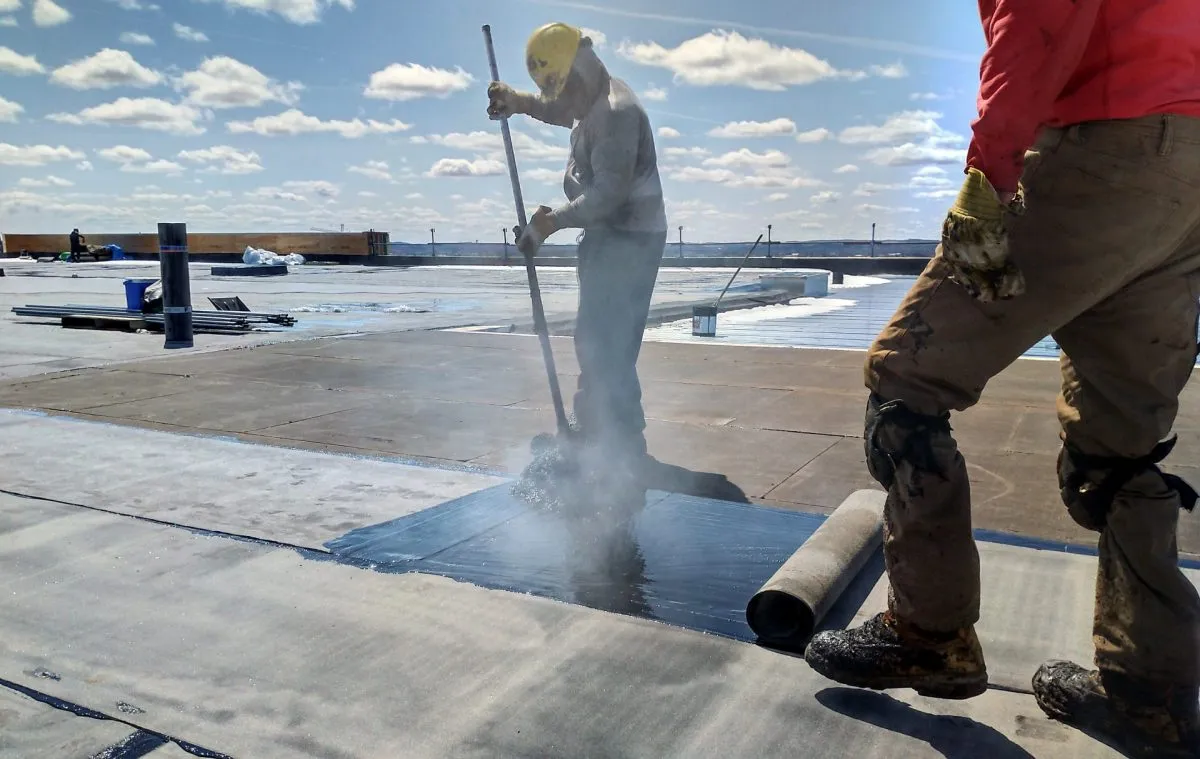
When the survey shows isolated wet zones in an otherwise dry roof, we cut them out, dry or replace the saturated insulation, restore the membrane over fresh board, and re-detail any flashings disturbed in the process. That repair only holds, though, if we address why the moisture got into the assembly in the first place. In this climate the vapor drive runs from the warm interior outward, which means the vapor retarder belongs low in the assembly, near the deck, not up under the membrane where it traps moisture against the cold side.
Recovering over an assembly with a misplaced or failed vapor barrier just rebuilds the same trap inside a brand-new roof, and the owner pays twice. So part of every moisture repair we do is an honest look at how the assembly manages vapor, and a recommendation that the corrected system keep the retarder on the warm side where it belongs. When saturation covers a large share of the field or the deck has already corroded, we say so plainly and price a replacement, rather than sell a patch we know will not hold.
An infrared survey after sunset. Insulation holding water releases its stored daytime heat more slowly than dry board, so the wet zones read warmer in the thermal image as distinct shapes. We confirm those areas with core cuts, which also reveal the saturation depth, the deck condition, and how the existing vapor barrier was installed.
Warm, humid interior air carries vapor upward into the assembly. When it reaches the cooler underside of the membrane it condenses. If the vapor retarder is missing, damaged, or installed above the insulation instead of near the deck, that condensation collects in the insulation, corrodes the deck, and blisters the membrane, all without a single rain leak.
If the wet area is isolated and the surrounding field is dry, yes. We cut out the saturated insulation, replace it with dry board, restore the membrane, and re-detail the affected flashings. Once moisture covers a large share of the roof, or the deck has corroded, replacement is the sound decision, and the survey tells us which case you are in.
Steadily, and it accelerates. Wet insulation gives up no thermal resistance, so cooling costs rise while the problem grows, and standing moisture keeps corroding the deck. A roof with a modest wet area left for a couple more seasons can show a far larger saturated share at the next survey, turning a manageable repair into a full replacement.
Localized repairs are priced by the affected area, based on insulation depth, deck condition, and how much membrane work the zone needs. We often credit the survey fee toward the repair if we do the work. Where widespread saturation forces a full replacement, that is priced at the reroofing rate plus any deck remediation. You get separate numbers for the survey, the targeted repair, and the replacement so you can choose with the figures in front of you.
Membrane seams, fasteners, curbs, penetrations, edge metal, and drainage paths are reviewed before any repair scope is recommended.
Work windows, tenant access, equipment protection, and safety needs are considered so roof work fits the building’s operating rhythm.
Photos, notes, measurements, and priorities are organized into a roof plan that helps ownership choose the next move with less guesswork.