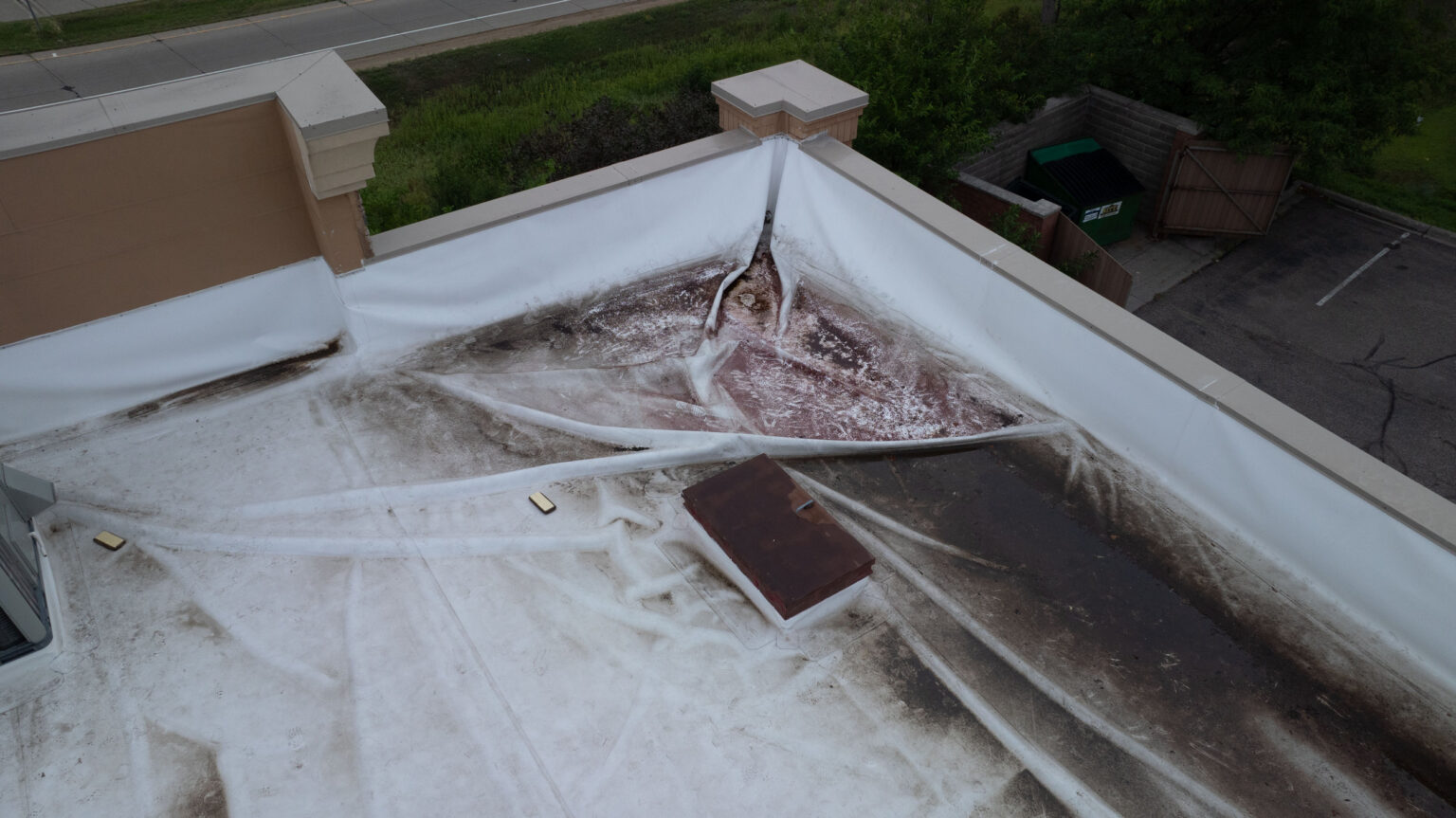
Metal and equipment first
Rooftop units, vents, and edge metal often show clear hail impact before the membrane does, and help establish storm size.
 Request Roof Walk
North Alabama's spring storm season brings hail that can bruise a low-slope commercial roof without leaving an obvious mark from ground level. We document the impacts a claim needs before they're written off as normal wear.
Hail damage on a steep residential shingle roof is often visible from the ground. A commercial membrane roof hides the same event underneath a flat, uniform surface. A TPO or EPDM membrane can absorb an impact without tearing, while the insulation board underneath bruises and loses compressive strength. That difference is why hail claims on commercial roofs get denied more often than they should, the damage is real, but it takes a roof-level inspection with core probes to show it.
Huntsville and Madison County sit inside a corridor that sees hail during spring severe-weather season, usually riding along the same storm systems that bring damaging straight-line wind and, on the worst days, tornado warnings. A hail event large enough to dent rooftop HVAC housings, vent caps, or exposed metal edge trim is usually large enough to have affected the membrane and insulation below it too.
We start at the roof edges and rooftop equipment, where hail damage shows up first and most clearly: dented condenser fins, cracked or split vent caps, denting on gutter and coping metal, and pitting on any exposed metal flashing. Those marks establish that a hail event of a certain size hit the roof, which supports the claim even before we assess the membrane itself.
From there we walk the field of the roof looking for bruising, soft, slightly depressed circles where the membrane has been driven into the insulation below. On single-ply membranes we probe suspect areas and, where appropriate, pull a small core sample to show the insulation damage directly. We photograph and measure impact density across each roof section rather than pointing to a few isolated marks, because carriers weigh pattern and density heavily when evaluating a hail claim.
Our report separates confirmed hail impact from other conditions we find on the same roof, ponding water, aged flashing, or prior repair patches, so the carrier can evaluate the storm-related damage on its own terms. We're your roofing contractor, not a public adjuster: we document and substantiate what the hail did to the roof so the owner and their adjuster are working from an accurate scope, not a guess.
Timing matters with hail. Impact marks on some membranes can be harder to distinguish from ordinary surface wear the longer they sit, and most commercial policies expect timely notice of loss. An inspection soon after a storm, with dated photos and measurements, gives the strongest record if the claim is questioned or if a later inspection is needed to compare damage progression.
A hailstorm doesn't distinguish between a downtown office roof, a research and technology building near Redstone Arsenal, and a distribution roof out toward Jetplex Industrial Park, all of them sit under the same north Alabama sky. What changes building to building is access: a secure research-park tenant roof and a logistics roof with active dock traffic both need scheduling and safety planning built into the inspection, which we account for before setting a roof-walk date.
Yes. Hail bruises insulation and dents metal components under a membrane surface that can look intact from the ground or even from a quick roof walk. The damage shows up as soft spots, granule loss, or metal denting once someone probes the surface.
As soon as reasonably possible. Bruised insulation and displaced granules can be hard to date months later, and most policies require timely notice of loss. An inspection soon after the event gives the clearest record for the claim.
Photos of impact marks, probe or core samples showing insulation bruising, measurements of dent size and density across roof sections, and notes on rooftop equipment, vents, and edge metal, which often show hail impact more clearly than the membrane itself.
Not necessarily. Coverage depends on whether the impacts caused functional damage, the policy's cosmetic-damage language, and the carrier's assessment. We document what we find; coverage decisions are made by the owner's carrier.
Rooftop units, vents, and edge metal often show clear hail impact before the membrane does, and help establish storm size.
Suspect membrane areas get probed, and where useful, cored, to show bruised insulation under an intact-looking surface.
Impact counts are measured across roof sections, not cherry-picked, so the file reflects the real extent of the storm.